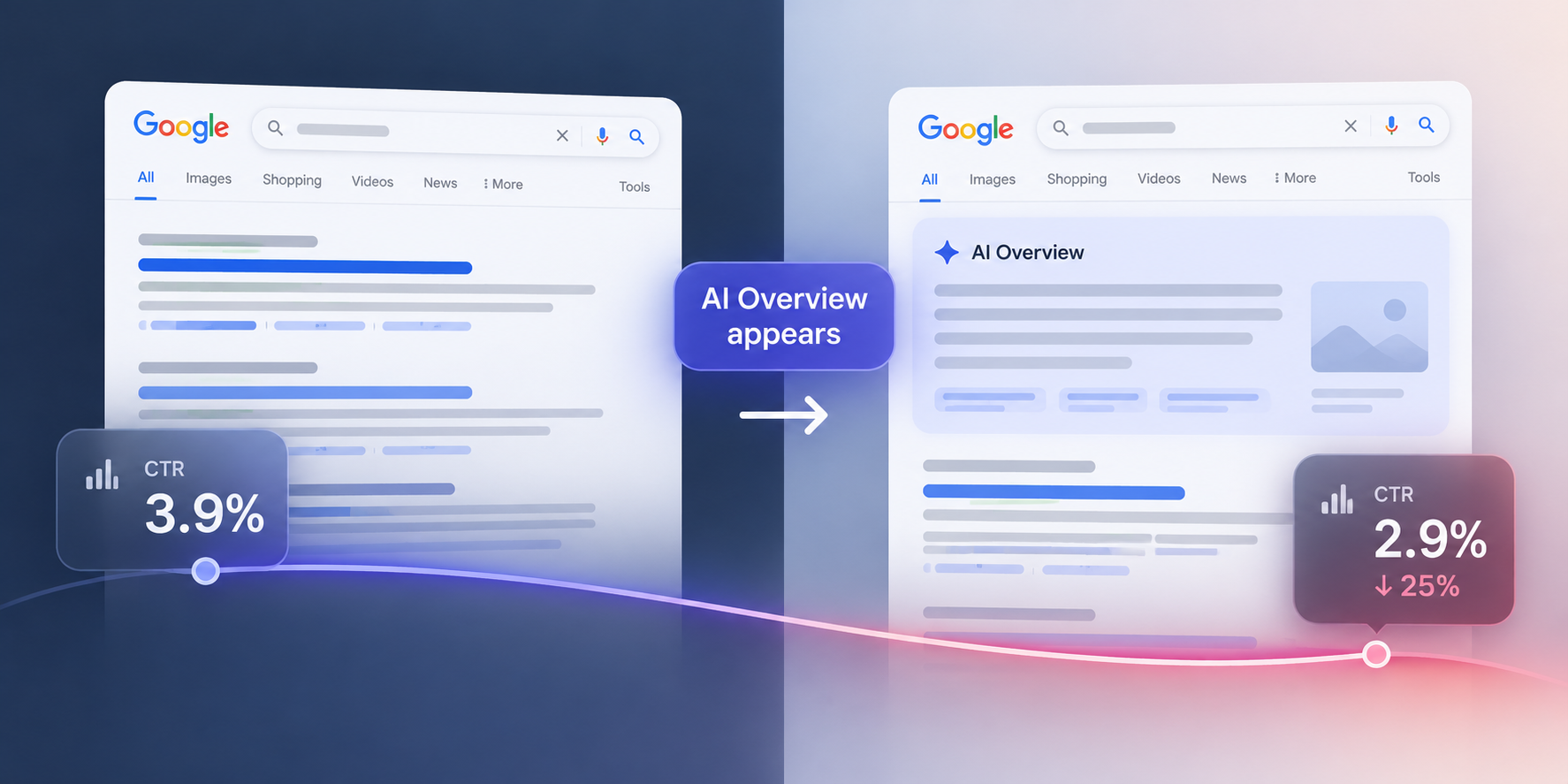
AI Overviews do not affect organic clicks uniformly. An analysis of non-branded search queries for an anonymous service brand revealed a clear difference between queries where an AI Overview appeared and those where it was already present.
When an AI Overview appeared, impressions remained broadly stable, but clicks declined and click-through rate fell noticeably.
Queries that already had an AI Overview showed a different pattern. Their impressions and clicks declined together, while CTR remained broadly unchanged.
The findings suggest that the arrival of an AI Overview may have a more immediate relationship with organic click-through rate than its continued presence. Here is how the analysis was conducted, what the results suggest, and where the limitations matter.
The setup
We compared search performance across two snapshots taken at different points in the year. The brand and underlying keyword dataset remain anonymous, and the findings are presented in qualitative terms rather than as exact performance figures.
The analysis began with non-branded keywords identified by a SERP rank-tracking platform as displaying an AI Overview in the later snapshot. These keywords were matched with available Google Search Console data to examine changes in impressions, clicks and click-through rate.
The matched keywords were divided into two groups:
- Newly appearing AI Overview: the query did not display an AI Overview in the earlier snapshot but did in the later one.
- AI Overview present throughout: the query displayed an AI Overview in both snapshots.
The second group provides a useful comparison, although it is not a true control group. The analysis did not include a separate group of queries that remained consistently free of AI Overviews.
To reduce the influence of other factors, the comparison focused on keywords with relatively stable tracked rankings. A seasonal segment with an unusually sharp decline in demand was also excluded from the primary comparison.
These safeguards helped make the groups more comparable, although they cannot eliminate every source of bias.
The method: separating demand from click-through rate
A decline in organic clicks can have different explanations. Search demand may have fallen, impressions may have changed, or a smaller proportion of searchers may have clicked through to the website.
To distinguish these effects, we decomposed the change in clicks into an impression-driven component and a CTR-driven component.
[
\text{Impression effect} =
(\text{Later impressions} – \text{Earlier impressions})
\times \text{Earlier CTR}
]
[
\text{CTR effect} =
\text{Later impressions}
\times
(\text{Later CTR} – \text{Earlier CTR})
]
This approach changes one factor at a time, allowing the two components to reconcile with the overall click change.
The distinction matters because declining impressions and declining CTR represent different challenges. The former may reflect changes in demand or visibility, while the latter indicates that impressions are generating fewer organic clicks.
However, even when CTR declines, the calculation does not establish why users are less likely to click.
Finding: when an AI Overview appears, CTR comes under pressure
Queries that gained an AI Overview maintained broadly stable impression levels, yet organic clicks declined noticeably.
The difference was primarily associated with weaker click-through rate rather than a corresponding reduction in impressions.
This suggests that the website continued to receive search visibility, but a smaller share of searchers clicked through to its organic listing.
One possible explanation is that an AI Overview satisfies some users’ information needs before they visit an external website. Another is that the additional SERP feature changes the prominence and position of traditional organic results.
Both explanations are plausible, but the available observations cannot isolate the contribution of each factor.
The important takeaway is that stable impressions do not necessarily translate into stable organic traffic when the search results page changes.
Finding: when the AI Overview is already present, CTR is more stable
The comparison group followed a different pattern.
For queries where an AI Overview was present in both snapshots, impressions and clicks moved in broadly similar directions, while CTR remained relatively stable.
This suggests that the decline in organic clicks was more closely associated with reduced search activity than with a further deterioration in click-through rate.
It also highlights why measuring AI Overview presence alone may be insufficient. The point at which a feature first appears could be associated with a different performance pattern from its continued presence.
That distinction deserves further investigation across additional datasets and search categories.
[Optional chart: qualitative comparison of newly appearing and previously established AI Overviews. Show directional trends only, without exact values.]
Finding: group averages can tell the wrong story
Average CTR is influenced by more than changes in individual keywords. It can also change when the composition of a group shifts.
For example, a group may contain queries that usually attract relatively high CTR alongside queries that attract very few clicks. If impressions shift disproportionately towards either type, the group’s average can change even when individual keyword performance has not improved or deteriorated in the same way.
The analysis highlighted several important cases.
Seasonality can exaggerate the apparent effect.
A seasonal segment experienced a substantial decline in search activity after its peak period. Because these queries typically attracted a relatively high click-through rate, their changing contribution affected the group’s overall average.
Removing the segment produced a more balanced comparison and reduced the risk of attributing seasonal behaviour to AI Overviews.
CTR can improve even as traffic falls.
Some seasonal queries recorded lower impressions and clicks alongside stronger CTR. One possible explanation is a shift in search intent: casual researchers may disappear after the peak period, leaving users with a more immediate need for the service.
This remains a hypothesis rather than a demonstrated cause. Changes in the keyword mix may also account for part of the movement.
An apparently better average can conceal weaker keyword performance.
A specialist segment showed an improvement in average CTR that was largely explained by changes in the distribution of impressions.
Queries with negligible click activity lost visibility, changing the weight of different keywords in the group average. At individual keyword level, performance was frequently less positive than the aggregate result suggested.
The broader lesson is to investigate changes within comparable keyword groups before interpreting an overall average as evidence of improvement or decline.
Finding: high-volume queries matter most
The aggregate CTR decline was not distributed evenly across all keywords.
A relatively small group of high-volume queries contributed disproportionately to the overall change. Generic searches and location-modified service queries were particularly important in explaining the pattern.
Long-tail queries with little search activity had less influence on the aggregate result.
This has practical implications for monitoring. A website-wide CTR average may conceal a meaningful change in the queries that contribute most to organic traffic.
The analysis also highlighted a potential difference between tracked rankings and the positions reported in Search Console. Tracked rankings remained relatively stable by design, while impression-weighted Search Console positions weakened for the group where AI Overviews newly appeared.
This is consistent with the possibility that changes to the results-page layout affect organic visibility, even when conventional rank tracking suggests limited movement.
However, the observations cannot distinguish the effect of the AI Overview itself from the effect of the changing layout around it.
Keyword-level analyses also did not establish a consistent independent effect across the dataset. The aggregate pattern should therefore be interpreted as an association that warrants further investigation, not as a universal outcome for every query.
What SEO teams should do
Monitor changes in AI Overview presence. Record when a feature first appears, rather than tracking presence alone. This creates a clearer basis for investigating changes in organic performance.
Separate impression and CTR movements. Determine whether a traffic decline is associated with weaker search demand, reduced visibility or a lower propensity to click. Each points towards a different potential response.
Control for rankings and seasonality. Compare queries with broadly stable rankings and investigate seasonal segments separately before attributing traffic changes to a SERP feature.
Analyse comparable groups. Review performance within keyword segments instead of relying exclusively on averages. Changes in the mix of queries can conceal the underlying behaviour.
Prioritise high-volume queries. Investigate important generic and location-based searches when AI Overviews appear. Review organic visibility, available citation information and Search Console performance together.
Extend the measurement framework. Where possible, record whether a brand is cited within the AI Overview. Citation presence could help distinguish changes in organic click behaviour across different types of AI-generated results.
Limitations
This analysis covers an anonymous brand’s non-branded search performance across a limited number of snapshots. It should not be treated as representative of all industries, websites or search intents.
Seasonality and changes in user demand may have influenced the observed movements. The comparison group provides useful context but does not establish what would have happened without AI Overviews.
Rank tracking records observed search results under specific tracking conditions, whereas Google Search Console aggregates performance across users, devices and locations. The datasets therefore do not necessarily represent identical search experiences.
The analysis also cannot establish whether AI Overview citations influence clicks, as citation status was not incorporated into the comparison.
Further research across additional websites, search categories and observation periods would help determine how consistently these patterns occur.
The central conclusion is that AI Overview presence alone is not enough to explain organic performance. Understanding when the feature appears, how impressions and CTR change, and how individual query groups behave provides a more useful foundation for SEO decision-making.